Stronger Social Connectivity
More than 5 million
people are playing the online word game Words With Friends on Facebook. And
most of them are playing it with their moms.
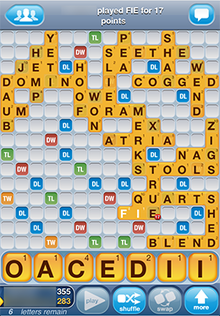
When the game was released in
2007, it became the first Facebook application to achieve a mass audience, and
the familiarity of the gameplay was one of its main attractions. If you know
how to play Scrabble, then you already know how to play Words With Friends—it’s just a slightly modified and
unauthorized version of the classic board game, combined with online chat.1
There’s no time limit on turns, and games stay active even when you log out of
the social network. Whenever it’s your turn, Facebook sends you an alert to
your home page, your e-mail, or your mobile phone.
Here’s how one Words With Friends
reviewer sums up its cross-generational appeal: “Everyone in your social
network, even your mom, knows how to play Scrabble.” 2 No
doubt that’s why so many of the online rave reviews include the phrase “my mom”—like
this one: “I live in Atlanta, and my mom’s in Texas. We love to have game night
across the miles. Although I am sure she needs a break from me kicking her butt
all of the time. (Love you, Mom!)”3
I’ve been reading game reviews
for most of my life and I’ve never seen anything close to this many mom
references. In fact, it’s not that much of a stretch to say that, for many, the
primary reason they play Words With
Friends is to have an excuse to talk to their mom every day.
It’s not just online reviews that
have given me this suspicion—there’s photographic evidence as well. Words With
Friends games are private, but players often post screenshots of their most
triumphant moments on photo-sharing sites like Flickr and Photobucket. In these
screenshots, which usually have titles like “Online Scrabble with Mom” or “In
Which I Beat My Mother at Words With Friends,” you get a glimpse of the kind of
everyday familial checking-in that runs alongside the wordplay.4
Much of the chat is mundane game talk, but you also see a constant stream of
catching up, like these messages spied on Flickr: “Have you started your
internship yet? How is that going?”5 and “Knee still hurt.
Putting a lot of ice on it.”6 Or “What are you doing after
work?” and “Your stepfather says hello.”7 Some chat messages
simply express users’ happiness to be playing together, like this one from a
mom to two daughters: “Glad to see you two, even if you do spank me when we
play. :)”8 Of course, there are tons of messages that simply
say: “I love you.”9
Judging from the shared
screenshots, it’s not just moms whom
players use Words With Friends to keep in touch with daily. There are also
plenty of running games against dads, cousins, siblings, in-laws, former
coworkers, faraway friends, and spouses on business trips. (That’s when I most
frequently play Words With Friends—I keep a game running against my husband
when I’m traveling for work. It helps me feel like we’re actually doing
something together, not just checking in.)
Because you don’t have to be
online playing at the same time, it’s easy to organize a game with anyone else,
no matter where or how busy they are. You can easily keep up with the game by
playing literally only a few minutes a day. And by keeping running games going with
your real-life friends and family, you’re ensuring daily opportunities to
actively connect with the people you care about most.
The tight-knit nature of the Words
With Friends game world wasn’t a necessary outcome of the game’s design. On
Facebook, you can technically start a Words With Friends game with anyone—even
people you don’t know—but most people play against people they already count as
Facebook “friends.” Playing Words With Friends is checking in with our loved
ones, but with a purpose. For anyone who has ever needed a gentle reminder to
stay in touch, Words With Friends provides a motivation. It helps us stay
actively connected, by reminding us that it’s literally “our turn” to say
something. And when there’s a game on the line, suddenly staying in touch is
not just pleasant and gratifying—it is also addictive.
The secret to the addictiveness
of Words With Friends is its asynchronous
gameplay: players don’t have to be online at the same time, and can take their
turns whenever they want. Some Words With Friends games go quickly, with
players trading words every few minutes, but many games go quite slowly, with
players taking just one or two turns a day, or even less often than that.
The unpredictable rhythm of
asynchronous play adds a measure of anticipation. You’re thinking about your
next play, but you don’t know when you’ll be able to make it. You’re motivated
to act, but you have to wait for your Facebook friends to check back into the
game. And because you often have no idea if your friends are still logged on or
paying attention to the game, there’s an emotional buildup to waiting for their
next moves. As one player puts it, “You have to be addicted AND patient.”10
The addictiveness of the game
pushes us to initiate social interaction with members of our extended social
network whom we might ordinarily leave out of our daily life online. Indeed,
starting a new game with someone is making a commitment to interact with them
at least a dozen or so times in the near future. And when you’ve got five or
ten or twenty games going at once, you’ve effectively scheduled hundreds of
microinteractions with people you like into your everyday routine.
According to user metrics
reported in an article in the Wall Street
Journal, on average one-third of registered Words With Friends players at
any given time have logged in at least thirty straight days in a row.11
This is a measure of the remarkable stickiness
of social network gaming—it capitalizes brilliantly on the increased motivation
we feel when we play a good game. It leverages our increased interest and
optimism to help us satisfy our often otherwise thwarted desire to feel more
connected with friends and family.
Simply put, social network games
make it both easier and more fun to maintain strong, active
connections with people we care about but who we don’t see or speak to enough
in our daily lives.
Eric Weiner, an independent
foreign correspondent and author of The
Geography of Bliss, has covered happiness trends throughout the world. His
research has confirmed for him that “our happiness is completely and utterly intertwined
with other people: family and friends and neighbors.... Happiness is not a noun
or verb. It’s a conjunction. Connective tissue.”12 Games like
Words With Friends are intentionally designed to strengthen the connective
tissue within our social networks. Each move we make in the game is a
conjunction.
We clearly need more social
conjunctions in our lives. As numerous economists and positive psychologists
have observed, globally we make the mistake of becoming less social the richer
we become as individuals, and as a society. As Weiner observes: “The greatest
source of happiness is other people—and what does money do? It isolates us from
other people. It enables us to build walls, literal and figurative, around
ourselves. We move from a teeming college dorm to an apartment to a house and,
if we’re really wealthy, to an estate. We think we’re moving up, but really we’re
walling off ourselves.”13
Games like Words With Friends can
help us start chipping away at those walls. Words With Friends was the first
breakthrough social network game, but since its success, the genre has
experienced dramatic growth—particularly on Facebook.

No comments:
Post a Comment